
Blog
Types of Recreational Boats: Which One Suits You Best?
Understanding the main types of boats used for leisure helps you choose the right option according to your sailing plan, the skipper’s experience, the number of people on board and the type of trip you want to enjoy. Looking for a simple boat for a short coastal outing is not the same as choosing a comfortable vessel for several hours at anchor, a longer route or a group experience.
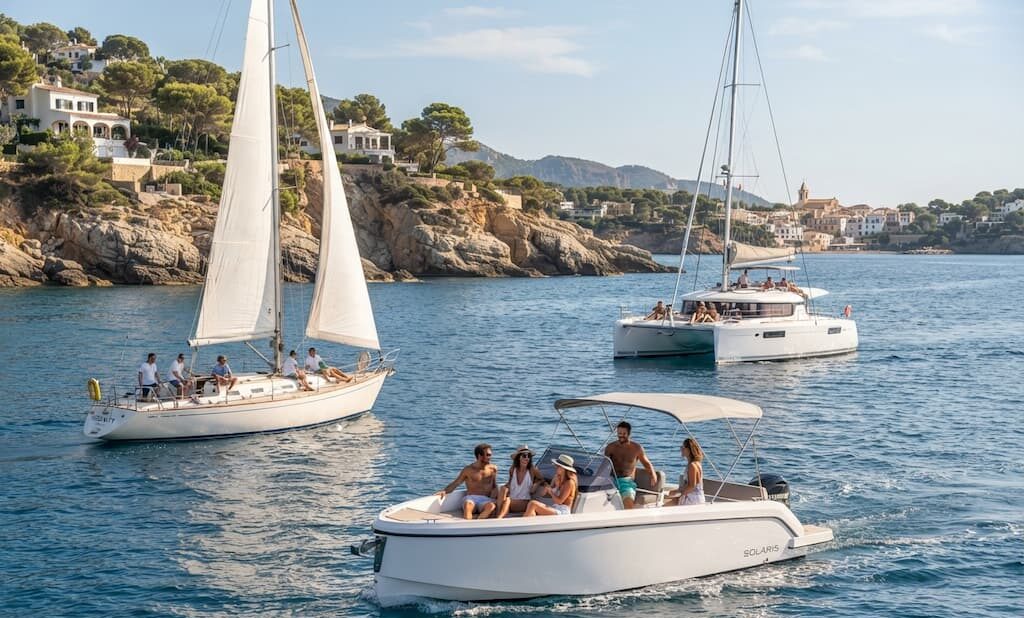
In recreational boating, there are motorboats, licence-free boats, RIBs, sailboats, catamarans, yachts and cabin boats, among other options. Each one offers different advantages in terms of stability, speed, space, fuel consumption, comfort and ease of handling.
In this article, you will learn about the main recreational boats, what each one is used for and which factors you should consider before choosing: length, capacity, licence requirements, weather, route, duration of the trip and expected comfort level.
What types of recreational boats are there?
Recreational boats are vessels intended for leisure, private sailing, coastal trips, sport fishing, swimming, anchoring or short crossings. Their size, power and equipment can vary greatly, from compact boats for short outings to larger vessels with a cabin, bathroom, galley or rest areas.
They can be classified by size, hull shape, propulsion system or main use. However, for someone looking for practical guidance, it is more useful to distinguish between easy-to-handle boats, vessels for groups, sportier options and models designed for greater onboard comfort.
- Licence-free boats: small, simple vessels designed for limited coastal navigation.
- Motorboats: fast, versatile and suitable for trips, swimming or water sports depending on power and equipment.
- RIBs: lightweight, stable and often used for sporty outings or dynamic navigation.
- Sailboats: ideal for those looking for calmer, more technical sailing that depends more on wind conditions.
- Catamarans: spacious, stable and comfortable for groups, events or relaxed outings.
- Yachts and cabin boats: focused on greater comfort, longer trips and navigation with more onboard services.
Licence-free boats and motorboats
Licence-free boats are often one of the most accessible options for getting started in recreational boating. They usually have a reduced length, limited power and are designed for daytime outings close to the coast or departure port. Even so, not requiring a licence does not mean they can be used without responsibility: it is necessary to understand basic navigation rules, permitted areas, weather conditions and safe manoeuvres.
Motorboats, on the other hand, offer more speed, capacity and performance. They can be used for coastal trips, anchoring, swimming, recreational fishing or tow sports, provided that the model, power and regulations allow it. In many cases, operating them requires the appropriate nautical licence or qualification.
When should you choose a motorboat?
A motorboat may be suitable if you are looking for a flexible outing, quick movements and stops at different points along the coast. It is a practical option for small or medium-sized groups that prioritise mobility, swimming and straightforward navigation over large relaxation areas.
When comparing options for Boat rental Malaga, it is worth checking the boat’s length, maximum capacity, whether a licence is required, whether a skipper is included and what type of use the vessel actually allows according to the planned route.
Which boat should you choose according to your sailing plan?
The choice should not be based only on the appearance of the boat. The best type of vessel depends on what you want to do at sea. For a short outing near the coast, a small boat may be enough. For several hours at anchor, swimming or sailing with children, more space, shade and stability may be more important.
If the goal is to enjoy a relaxed experience, with scenic sailing and without having to handle the vessel, an organised boat trip may be more suitable than renting a boat on your own. However, if you have the right licence and experience, a motorboat can offer more freedom to plan the route within the permitted limits.
- For beginners: a licence-free boat or a skippered vessel.
- For small groups: a motorboat or RIB, depending on the type of outing.
- For comfort and stability: a catamaran or a boat with greater beam.
- For technical sailing: a sailboat, especially if the goal is to learn and make use of the wind.
- For more comfort: a cabin boat or yacht, particularly for longer trips.
When the aim is to enjoy the sea without worrying about manoeuvres, the route or licence requirements, a Boat trip Malaga may be a better fit than a bareboat rental, especially for families, visitors or groups looking for a simple experience.
Catamarans, sailboats and cabin boats
Catamarans stand out for their stability and spaciousness. Because they have two hulls, they offer a wider and more comfortable platform than many monohull boats of a similar length. This makes them especially interesting for groups, relaxed celebrations, anchoring, outings with children or people who prefer a more stable sailing experience.
Sailboats have a different approach. Their appeal lies in sailing under wind power, silence, technique and the feeling of moving forward by using the wind. They can be very enjoyable for those who value the nautical experience itself, although they require more knowledge and depend more heavily on weather conditions.
Cabin boats and yachts provide greater comfort: cabin, bathroom, indoor areas, sun deck, galley or spaces to rest. They are suitable for longer trips, although they usually involve higher costs, more licence requirements and more detailed planning.
Why is a catamaran comfortable for groups?
A catamaran usually offers more usable deck space, less heeling and a feeling of stability that many people appreciate while anchoring or sailing gently. That is why, when comparing different types of boats, it often appears as a balanced option for groups that prioritise comfort and space.
For group outings, private events or relaxed navigation, Catamaran rental Malaga is usually associated with experiences where space, stability and life on board matter more than speed.
Do you need a licence to sail a recreational boat?
The need for a licence depends on the boat’s length, power, type of vessel, distance from the coast and applicable regulations. In Spain, there are different recreational boating qualifications, such as the navigation licence, PNB, PER, yacht skipper and yacht captain. Each one allows certain types of vessels and navigation areas.
As a general guide, the navigation licence allows you to operate recreational boats of up to 6 metres in length and class C jet skis, with daytime navigation and distance limitations. For larger vessels, more power, greater distance or more demanding navigation, higher qualifications are usually required.
There are also boats that can be used without a licence, provided they meet certain conditions related to length, power and navigation area. Even so, it is advisable to receive clear instructions before departure, check the weather forecast, understand buoyed areas and know how to respond to an incident.
In any case, before choosing a boat, it is important to confirm what licence the specific vessel requires, whether it can be hired with a skipper and what limits current regulations establish for the planned route.
Summary: how to choose between the different types of boats
The main types of recreational boats include licence-free vessels, motorboats, RIBs, sailboats, catamarans, yachts and cabin boats. Each one responds to a different need: beginner outings, speed, stability, comfort, technical sailing or longer trips.
To choose well, consider the number of people, the duration of the outing, the skipper’s experience, the available licence, the budget, the weather and the planned use. A small vessel may be enough for a coastal trip, while a catamaran or cabin boat may offer more comfort on longer outings or with groups.
In summary, there is no ideal boat for everyone. The best choice is the one that fits the real sailing plan, the level of experience, the sea conditions and the safety and comfort needs of everyone on board.