
Blog
Boat Licenses and Types of Navigation Licenses
Welcome to a new OceaNautic article! Today we will discuss a topic that many clients ask us about: the boat license and types of navigation licenses. Keep reading and learn with us.
What is a boat license?
To navigate Spanish waters with recreational vessels, you need to hold a nautical qualification. Depending on the size of the vessel and the navigation distance from the coast, you can choose from different types of nautical qualifications.
A boat license is an official document issued by the competent authority that certifies the holder has met the necessary requirements to operate a vessel safely and legally. This document may vary in name and type depending on the jurisdiction, but generally involves demonstrating nautical skills, knowledge of maritime safety, and compliance with specific regulations.
A boat license is essential for those who wish to participate in nautical activities, ensuring a minimum level of competence and contributing to safety on the water. Just as with land vehicles, to operate a boat, it is necessary to obtain a permit that certifies you have the necessary knowledge to handle it.
The Directorate-General of the Merchant Marine or, failing that, the Autonomous Communities that have assumed these competencies (Canary Islands, Catalonia, Balearic Islands, Andalusia, Asturias, Galicia, Basque Country, Murcia, Cantabria, Valencia, Ceuta, and Melilla) are responsible for issuing these qualifications.
To obtain them, you must complete courses, pass theoretical exams, and undertake practical training on approved vessels. Royal Decree 875/2014 regulates recreational nautical qualifications in Spain, establishing the requirements and procedures for obtaining licenses for different categories of vessels.
When is a boat license required?
The need for a boat license to operate a vessel depends on several factors, such as jurisdiction, vessel type, and its use. Below are some common situations where a license is required for navigation:
- Recreational vessels: In many countries, a nautical qualification or license is required to operate recreational vessels. The license category may vary depending on the size and type of vessel.
- Engine power: In some locations, the need for a nautical qualification may depend on the vessel’s engine power. For example, it may be mandatory to obtain a license for vessels with engines of a certain power.
- Navigation area: Some licenses may be specific to certain navigation areas, such as inland waters or open sea. The complexity and requirements may vary depending on the navigation zone.
- Type of activity: If a specific activity is carried out on the vessel, such as sport fishing or diving, an additional license may be required.
- Operator’s age: For the navigation license or PNB qualification, there are minimum age requirements for holders.
It is important to verify the specific regulations of the jurisdiction in which you will be navigating to fully understand the requirements. Safety and legality are key aspects of navigation, and holding the appropriate license contributes to both.
Types of Boat Licenses and Recreational Vessel Licenses
Depending on the type of boat you wish to operate, you will need to choose a specific license. Here we explain the types of licenses available and how to obtain them:
Titulín or Navigation License
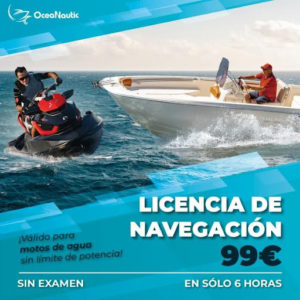
It is popularly known as Titulín in Malaga and is the most basic license of all, intended for those who want to navigate a small vessel or jet ski, without straying too far from the coast. It allows you to:
- Navigate vessels up to 6 meters in length and jet skis
- Daytime navigation only
- Minimum age 16 years
- You can go up to 2 miles from the coast.
To obtain it, you must complete a 6-hour course (two theoretical and four practical) without needing to take any exam. If you are interested in this license, we offer the course at the best price – contact us!
During the training, you will learn basic maneuvers within the port, pre-departure checks, and the most commonly used knots. You must also know basic right-of-way rules to avoid collisions, notions of safe navigation, and maritime signaling.
Basic Navigation Skipper License (PNB)
Would you like to go fishing at night? The PNB (Patrón de Navegación Básica – Basic Navigation Skipper) license is your qualification. This permit will allow you to navigate up to 5 miles from the coast in motor vessels up to 8 meters in length and with no power limit.
The minimum age to obtain this license is 16 years, and it also qualifies you for jet skis. Additionally, to obtain the PNB qualification, you must attend a course taught by an official school or federation, consisting of two theoretical hours and two practical hours in radio telecommunications. You will need to pass a multiple-choice exam, complete 8 practical hours on safety and navigation, and pass a medical examination.
Recreational Boat Skipper License (PER)
The PER license is a very popular boat license for enhancing the privileges offered by the basic license and allowing navigation with somewhat larger boats. It does not require any prior nautical qualification, which is why the PER (Patrón de Embarcación de Recreo – Recreational Boat Skipper) is the most common license.
Obtaining this qualification, which can be acquired from the age of 18, allows you to navigate a vessel whose length does not exceed 15 meters and to go a maximum of 12 miles from the coast.
It is possible to extend the PER’s privileges. To do so, you must complete a 24-hour navigation, including night navigation. Once completed, you will be able to operate vessels up to 24 meters in length and navigate between islands, both the Balearic and Canary Islands.
To obtain the PER, you need to complete a training course and practical sessions at a nautical school. The course must include 12 hours of short-range radio operator training (4 theoretical and 8 practical) and 16 hours of navigation practice. You will also need to pass a psychophysical examination and an official exam.
Yacht Skipper License
Do you prefer to skipper a yacht? You must obtain the Yacht Skipper License, which allows navigation in vessels up to 24 meters in length and up to a maximum distance of 150 miles.
The first requirement for obtaining it is to hold the PER license, which we discussed previously. You must also pass a theoretical exam and complete practical offshore navigation tests, consisting of a 48-hour voyage.
Boat License: Yacht Captain
This is the highest qualification for recreational vessels. It allows navigation in any type of vessel without navigation limits: day and night navigation, at any distance from the coast, and without length restrictions.
To obtain the Yacht Captain License, you must hold the Yacht Skipper License. You will also need to complete practical training on an approved vessel. These practices last 48 hours, of which a minimum of 36 will be under voyage conditions. Additionally, you must remain on watch for at least one full day and one full night.
Do you already know which boat license you will get? Whether you are sure or not, at OceaNautic we are specialists in navigation license courses, PNB and PER. Once you have your qualification, you can enjoy boat trips in Malaga or catamaran rental in Malaga. Our schedules are flexible, and we offer approved practical training. We look forward to seeing you!
We recommend you continue reading: What vessels can be operated without a license.