
Blog
Which side do you pass a cardinal mark? How to recognise them by day and night
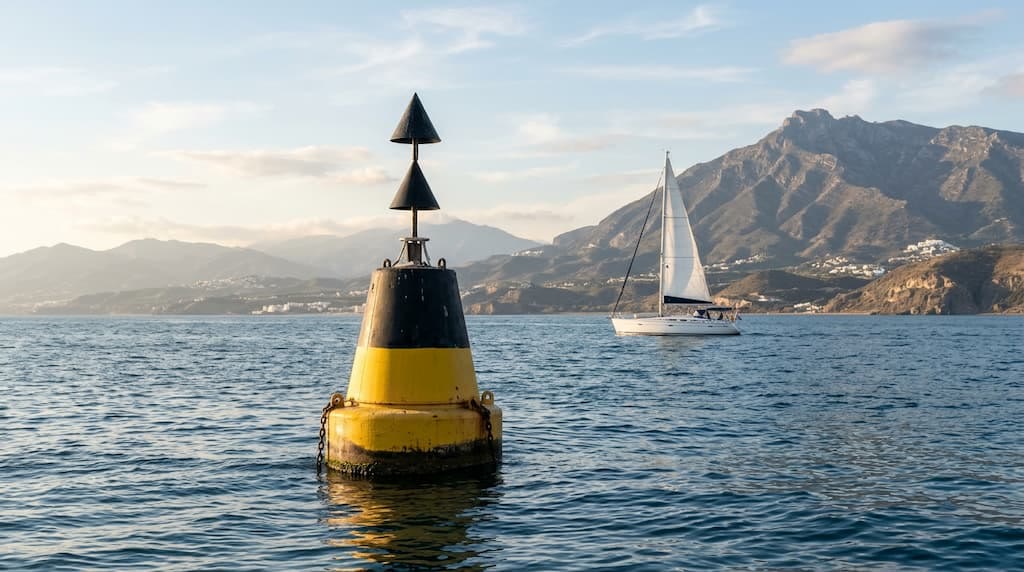
Cardinal marks are the buoys and beacons that tell you on which side of a hazard the safe water lies: north, south, east or west. Reading them at a glance, from their topmarks, colours and light, is a standard question in the Spanish PNB and PER exams and, above all, a safety skill when you sail near shoals, reefs or wrecks.
Which side do you pass a cardinal mark?
You always pass a cardinal mark on the side its name indicates: keep to the north of a north cardinal, to the south of a south cardinal, and the same for east and west. The mark is not on top of the danger; it sits on the side of it where the water is safe.
In other words, if you see a west cardinal, the danger lies to the east of the buoy and you must stay to the west. Unlike an isolated danger mark, you cannot pass a cardinal on either side.
How to recognise cardinal marks: topmarks, colours and lights
All four cardinal marks share the same colours (black and yellow) and a white light. What changes is the direction of the two cones in the topmark, the order of the bands and the number of flashes.
| Mark | Topmark cones | Colours (top to bottom) | White light | Pass on its |
|---|---|---|---|---|
| North cardinal | Both pointing up ▲▲ | Black over yellow | Continuous quick or very quick flashing | North side |
| East cardinal | Base to base, points outwards ▲▼ | Black, yellow, black | 3 quick flashes every 10 s (or 3 very quick every 5 s) | East side |
| South cardinal | Both pointing down ▼▼ | Yellow over black | 6 quick flashes plus one long flash every 15 s (or every 10 s) | South side |
| West cardinal | Point to point ▼▲ | Yellow, black, yellow | 9 quick flashes every 15 s (or every 10 s) | West side |
The trick for cones and colours
The cones point to where the black is. Both up (north): black on top. Both down (south): black at the bottom. Bases together (east): black top and bottom. Points together (west): black in the middle. With this rule you do not need to memorise the colours separately.
The trick for lights: the clock face
The flashes follow a clock: east is at 3 o’clock (3 flashes), south at 6 (6 flashes) and west at 9 (9 flashes). North, at 12, has no number: it flashes continuously. The long flash added to the south cardinal stops its 6 flashes being confused with the 3 or the 9 at night.
Cardinal marks within the IALA buoyage system
Spain uses the IALA buoyage system, Region A, adopted by Royal Decree 1835/1983. Cardinal marks are only one family; in the exam and at sea you need to tell them apart from the rest:
- Lateral marks: show the two sides of a channel. In Region A, entering harbour, the red (can-shaped) mark is to port and the green (conical) mark to starboard.
- Isolated danger mark: black with red bands and two black spheres on top; white light in groups of 2 flashes. It sits on a small danger with navigable water all around.
- Safe water mark: red and white vertical stripes, one red sphere and a white isophase, occulting or single long flash every 10 s. It marks safe water, such as a channel entrance.
- Special marks: yellow, with an X topmark and a yellow light. They mark areas such as bathing zones, pipelines or military areas.
- Emergency wreck marking: blue and yellow vertical stripes with an alternating blue and yellow light, for a new danger not yet on the charts.
Cardinal marks are identical in Regions A and B; only the colours of the lateral marks change between regions.
Common mistakes with cardinal marks
- Passing too close: the mark shows the safe side, not the safe distance. Give it a wide berth and check the chart to see how far the shoal extends.
- Relying only on the light at night: count the flashes calmly and check the period; with swell and shore lights it is easy to mix up east and west.
- Confusing a cardinal with a lateral mark: cardinals are always black and yellow; laterals are red or green.
Learning cardinal marks for the PNB and PER
Buoyage is a full topic in the theory exam of the Spanish recreational boating licences, and cardinal marks are among the most repeated questions. At Oceanautic we cover it in the course and practise it at sea from Benalmádena marina. If you are preparing, have a look at the PER course in Malaga, the PNB course in Malaga or all our recreational boating licences. Not sure which one you need? Read PNB or PER.
To see how far from the coast each licence lets you go, and therefore what buoyage you will meet, check our guide to navigation zones.
Frequently asked questions
What does a north cardinal mark mean?
That the safe water is to the north of the mark and you must pass on its north side. It has two cones pointing up, is black over yellow and shows a continuous quick-flashing white light at night.
How do you remember the cardinal mark lights?
Use a clock face: east, 3 flashes; south, 6 flashes plus a long one; west, 9 flashes; north, continuous flashing. They match 3, 6, 9 and 12 o’clock.
What is the difference between a cardinal mark and an isolated danger mark?
A cardinal mark is placed on one side of a danger and tells you where to pass. An isolated danger mark sits on top of a small danger and can be passed on any side, keeping a safe distance.
Are cardinal marks the same everywhere?
Yes. In IALA Regions A and B cardinal marks have the same topmarks, colours and lights. Only the colours of lateral marks differ between regions.