
Blog
What should you do if someone falls overboard? Man overboard procedure step by step
If someone falls overboard, shout “man overboard!”, point at the person without losing sight of them, throw a lifebuoy and press the MOB button on the GPS. Then manoeuvre back to them with the engine under control and, if you cannot recover them within a few minutes, call Spanish Maritime Rescue (Salvamento Marítimo) on VHF channel 16 or on 900 202 202.
What to do in the first minute of a man overboard
The first minute decides almost everything: alert the crew, keep the person in sight, give them something that floats and save their position. With a little swell a head in the water is lost very quickly, so these four steps come before any manoeuvre.
- Shout “man overboard!” and the side they fell from, so everyone on board knows.
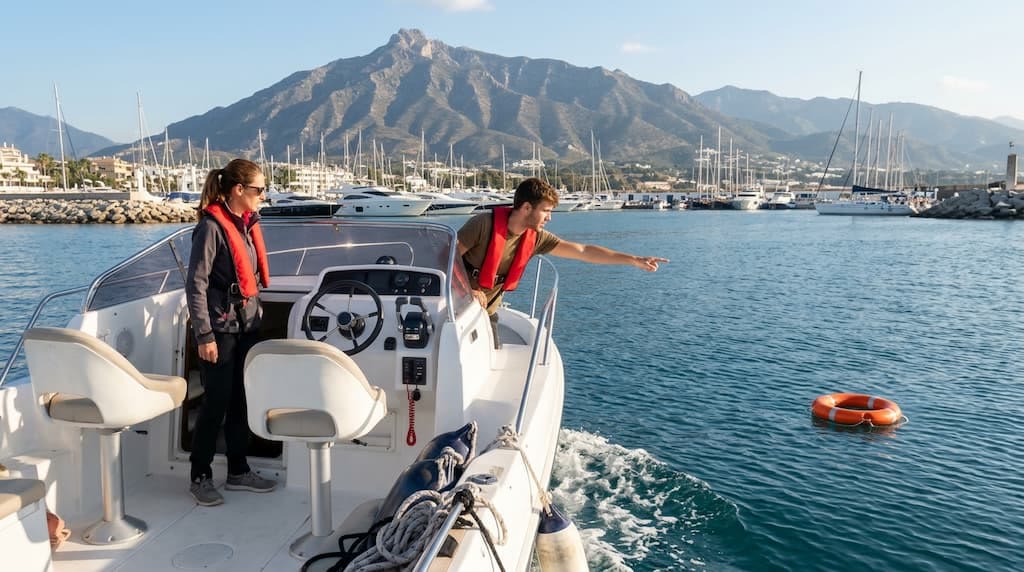
- Appoint a spotter whose only job is to watch the person and point at them with an outstretched arm, never lowering it.
- Throw the lifebuoy (with its light and line if fitted) and anything else that floats, such as a fender or a cushion. It helps the person and marks the spot.
- Press the MOB button on the GPS or chartplotter to store the exact position.
On a motorboat, also put the helm hard over towards the side the person fell from. This swings the stern and the propeller away from them.
Man overboard manoeuvres: which one to use
A man overboard manoeuvre gets you back to the person by the shortest route, arriving slowly with them in sight. The most common are the Anderson turn and the Williamson turn (known in Spain as the Boutakow curve), both studied for the PNB and PER; which one you use depends on whether you can see the person and on your boat.
| Manoeuvre | How it is done | When to use it |
|---|---|---|
| Anderson turn | Full helm towards the side of the fall and keep turning about 250° until you face the person; slow down at the end. | When the person is in sight and the boat turns well. It is the fastest. |
| Williamson turn (Boutakow) | Full helm towards the side of the fall; after about 60° of heading change, full helm the other way until you are on the reciprocal course. | At night or in poor visibility: it brings the boat back along its own wake to the point of the fall. |
| Scharnow turn | Full helm to one side; after about 240°, full helm the other way to the reciprocal course. | When the fall is noticed late and you need to return along the track already sailed. |
The final approach
The approach is the most delicate part. Come in slowly, with little way on, heading into the wind or current to keep control, and put the engine in neutral before you are alongside so the propeller is never near the person. Recover them over the side, away from the stern, using the bathing ladder or a line with a loop.
On a sailing boat
Under sail, a quick stop is usual: luff up, tack without releasing the jib and heave to close to the person. Before starting the engine, make sure there are no lines in the water.
When to call Salvamento Marítimo
If you cannot see the person, cannot reach them or cannot get them back on board, call for help straight away. A man overboard is grave and imminent danger, so send a MAYDAY on VHF channel 16 with the boat’s name, position (the MOB position), what has happened and how many people are on board.
Without a VHF, call Salvamento Marítimo on 900 202 202 or the emergency number 112. Find out how the service works in our maritime rescue guide for recreational boating.
Cold water: why time matters so much in winter
On the Costa del Sol the sea drops to around 15-16 °C in winter, and at that temperature the time available for a rescue gets shorter. It is often summed up as the 1-10-1 rule: one minute of cold shock (when you must control your breathing), about ten minutes of useful movement in your arms and legs, and around one hour before losing consciousness from hypothermia. Wearing a lifejacket is what gives you time for everything else.
How to prevent a man overboard
- Wear your lifejacket rather than keeping it in a locker, especially at night, in rough seas or when sailing alone.
- Harness and jackstay on a sailing boat when you have to go on deck in bad weather.
- Do not urinate over the side: it is one of the most frequent causes of falls overboard, especially at night.
- Check the forecast before leaving and do not push on in bad seas; here is how to weather a storm if it catches you out.
Practising the man overboard manoeuvre
The man overboard manoeuvre only works if you have practised it. It is part of the safety training for the Spanish boating licences, and at Oceanautic we train it with an object in the water from Benalmádena marina. More information on the PNB course in Malaga, the PER course in Malaga and our other recreational boating licences.
Frequently asked questions
What is the first thing to do if someone falls overboard?
Shout “man overboard!”, appoint someone to keep watching and pointing at the person, throw them a lifebuoy and press the MOB button on the GPS to save the position.
Which way do you turn the helm in a man overboard?
Towards the side the person fell from. This moves the stern and propeller away from them and starts the turn back to the point of the fall.
Which man overboard manoeuvre is best at night?
The Williamson (Boutakow) turn, because it brings the boat back along its wake to the point of the fall even if the person cannot be seen. If they are in sight, the Anderson turn is faster.
Who do you call if you cannot recover the person?
Salvamento Marítimo: MAYDAY on VHF channel 16 or phone 900 202 202. You can also call 112.